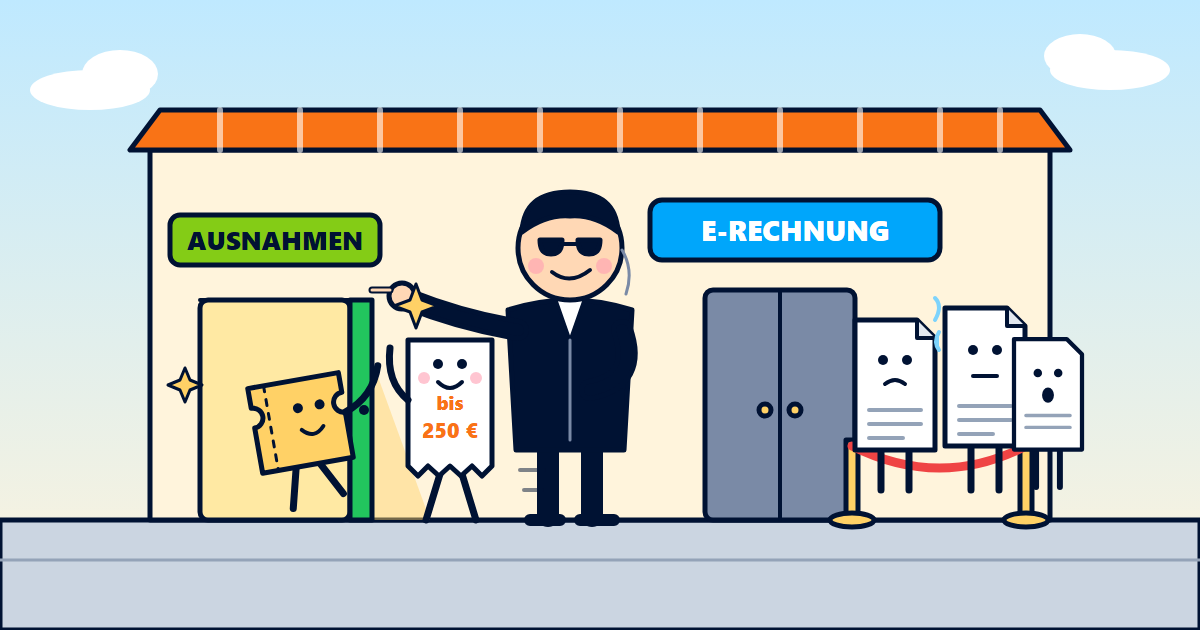
Invoices up to 250 €, tickets for passenger transport and invoices from small businesses (Kleinunternehmer) may, among others, always be other invoices, i.e. paper or, with the recipient's consent, for example PDF (§§ 33, 34 and 34a UStDV). Not affected at all are invoices to private individuals, invoices for tax-exempt supplies under § 4 nos. 8 to 29 UStG and invoices where you or your customer are not established in Germany. An e-invoice remains permitted in all these cases, in some only with the recipient's consent.
As of: Nov. 16, 2026
This guide is a machine translation of the German original as of Nov. 16, 2026. Only the German version is authoritative: read the German version. If you contact us, please write in German or English.
Two kinds of exceptions
Invoices between domestic businesses must in principle be issued as e-invoices; until the obligation begins on Jan. 1, 2027 or Jan. 1, 2028, transitional rules still allow other formats. From when this applies to you is explained in the article E-invoicing mandate 2027: the €800,000 threshold. For certain invoices, however, the obligation does not apply even after that. There are two kinds:
- Relief: the invoice would actually fall under the obligation, but may always be issued as an other invoice, i.e. on paper or in another electronic format such as PDF.
- No obligation: the conditions for the obligation are not met at all, for example because the customer is not a business.
The exceptions at a glance
You do not have to issue an e-invoice in the following cases, among others:
| Case | What applies | Legal reference |
|---|---|---|
| Invoice with a total amount up to 250 € (small-amount invoice, Kleinbetragsrechnung) | May always be an other invoice. | § 33 sentence 4 UStDV; BMF letter of 15 October 2025, marginal no. 22 |
| Ticket for passenger transport | May always be an other invoice. | § 34 para. 1 sentence 2 UStDV; BMF letter of 15 October 2025, marginal no. 22 |
| Invoice from a small business under § 19 UStG | May always be an other invoice. | § 34a sentence 4 UStDV; BMF letter of 15 October 2025, marginal no. 22 |
| Supply to a private individual | No obligation to issue an e-invoice. | § 14 para. 2 sentence 2 no. 1 UStG; section 14.1 para. 6 sentence 5 UStAE |
| Tax-exempt supply under § 4 nos. 8 to 29 UStG | No obligation to issue an e-invoice. | § 14 para. 2 sentence 2 UStG; section 14.1 paras. 3 and 6 UStAE |
| You or your customer are not established in Germany | No obligation to issue an e-invoice. | § 14 para. 2 sentence 2 no. 1 UStG; section 14.1 para. 6 sentence 3 UStAE |
| Supply to a legal person that is not a business | Obligation to issue an invoice, but no obligation to issue an e-invoice under the UStG. | § 14 para. 2 sentence 2 no. 2 UStG; section 14.1 para. 8 UStAE |
The sections of the VAT Application Decree (Umsatzsteuer-Anwendungserlass, UStAE) were revised by the BMF letter of 15 October 2025. “Established in Germany” means: the registered office, place of management, a permanent establishment involved in the supply or, without a registered office, the place of residence or habitual abode is in Germany; the areas under § 1 para. 3 UStG are included (§ 14 para. 2 sentence 2 no. 1 and sentence 3 UStG). Under § 33 sentence 3 UStDV, the relief for small amounts does not apply to invoices for supplies under §§ 3c, 6a and 13b UStG. More on small businesses is in the article Small businesses and e-invoicing.
What is not an exception
According to the BMF letter of 15 October 2025 (marginal no. 17 and section 14.1 para. 4 UStAE), the obligation also applies:
- if your customer is a small business or a farmer or forester or only makes tax-exempt supplies, for example lets a flat,
- for self-billed invoices (Gutschriften) and for supplies where the customer owes the tax (§ 13b UStG),
- subject to the other conditions, for tax-exempt supplies under § 4 nos. 1 to 7 UStG, because the exception only covers § 4 nos. 8 to 29 UStG,
- if only part of the invoice is taxable or you have waived a tax exemption under § 9 UStG.
If your customer cannot receive an e-invoice or refuses it, they have no claim to a different invoice. Your VAT obligations are deemed fulfilled if you have issued an e-invoice and demonstrably made an effort to transmit it (section 14.1 para. 5 UStAE).
If it is unclear whether the customer is a business
A breach of the obligation is not objected to as long as you did not know and, exercising the care of a prudent businessperson, could not have recognised that your customer bought as a business for their business. If the customer provides a VAT ID (USt-IdNr.), this can be an indication of this (section 14.1 para. 6 UStAE). In mass customer business with ongoing contracts and mixed customers, for example energy supplies, according to the BMF letter of 15 October 2026 (marginal nos. 5 and 6) it is sufficient to clarify this at the start of the contract or when the contract is changed.
Down payment invoices before the cut-off date
Down payment, advance payment and instalment invoices that you issue before your obligation begins do not have to be e-invoices, even if the supply and payment only follow afterwards (BMF letter of 15 October 2026, marginal no. 2).
Public contracting authorities: separate rules
Invoices to public authorities only fall under the obligation from the UStG if the authority acts as a business. Independently of this, suppliers to public contracting authorities may be obliged to issue e-invoices under other regulations, for the federal government for example under the E-Invoicing Ordinance (E-Rechnungsverordnung, ERechV). Both rules apply side by side; the stricter one prevails (BMF letter of 15 October 2026, marginal nos. 24 and 25). An exception under the UStG therefore does not release you from an obligation under these regulations. Usually an XRechnung with a Leitweg-ID is required there; if it is missing, the validation reports the rule BR-DE-15.
Voluntary e-invoices
The exceptions do not prohibit e-invoices. For small amounts, tickets and as a small business, you may send domestic businesses an e-invoice even without their consent. In the other cases, for example to private individuals or for tax-exempt supplies, an e-invoice requires the recipient's consent; this can also be given tacitly (section 14.1 paras. 6 and 7 UStAE).
How to proceed
- Use the E-invoicing mandate check to find out in four questions from when the obligation applies to you.
- Validate an e-invoice in the validator without an account against the official KoSIT validation rules.
- With a free account, create invoices in the web form and download them as a ZUGFeRD PDF or XRechnung.
Frequently asked questions
What exceptions are there to the e-invoicing mandate 2027?
Among others, invoices up to 250 €, tickets and invoices from small businesses may always be other invoices. In addition, there is no obligation for invoices to private individuals, for tax-exempt supplies under § 4 nos. 8 to 29 UStG and if one of the parties is not established in Germany.
Does the e-invoicing mandate apply to invoices under €250?
No. Under § 33 sentence 4 UStDV, an invoice whose total amount does not exceed 250 € may always be transmitted as an other invoice, i.e. on paper or, with the recipient's consent, for example as a PDF.
Does a ticket have to be an e-invoice?
No. Under § 34 para. 1 sentence 2 UStDV, tickets for passenger transport may always be issued as an other invoice.
Does the e-invoicing mandate apply to landlords?
Not for issuing, as far as the letting is tax-exempt under § 4 no. 12 UStG: for tax-exempt supplies under § 4 nos. 8 to 29 UStG, there is no obligation to issue an e-invoice. It is different if the landlord waives the tax exemption under § 9 UStG. A landlord must also be able to receive e-invoices.
Do I need an e-invoice for invoices to other countries?
No. The obligation only applies if you and your customer are established in Germany. Otherwise, you may invoice on paper or, with the recipient's consent, electronically.
Sources
- BMF-Schreiben zur Einführung der obligatorischen E-Rechnung zwischen inländischen Unternehmern (BMF letter on the introduction of mandatory e-invoicing between domestic businesses) (Oct. 15, 2025, III C 2 - S 7287-a/00019/007/243)
- BMF-Schreiben zur obligatorischen E-Rechnung – ergänzende Regelungen (BMF letter on mandatory e-invoicing – supplementary rules) (Oct. 15, 2026, III C 5 - S 7287-a/00019/021/017)
- § 4 UStG (Steuerbefreiungen) (tax exemptions)
- § 14 UStG (Ausstellung von Rechnungen) (issuing invoices)
- § 33 UStDV (Rechnungen über Kleinbeträge) (invoices for small amounts)
- § 34 UStDV (Fahrausweise als Rechnungen) (tickets as invoices)
- § 34a UStDV (Rechnungen von Kleinunternehmern) (invoices from small businesses)
- E-Rechnungsverordnung des Bundes (ERechV) (Federal E-Invoicing Ordinance)
This article summarises the sources listed in general terms and is not tax or legal advice. For your individual case, please consult a tax advisor.