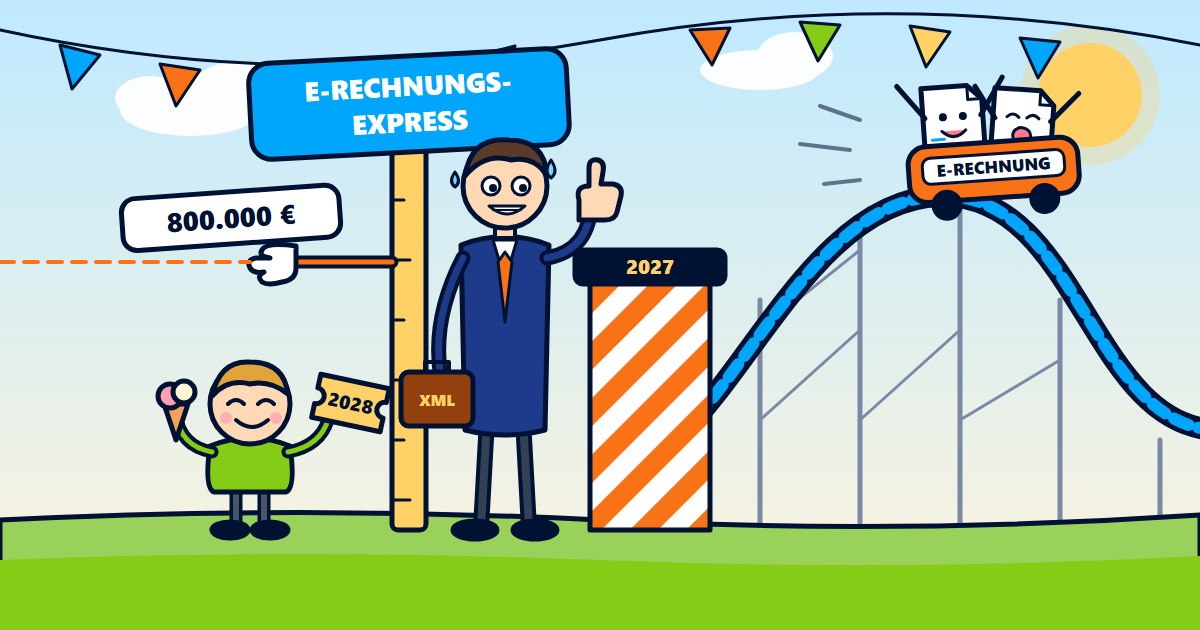
If your total turnover (Gesamtumsatz) in 2026 was more than 800,000 €, you must issue e-invoices for supplies to other domestic businesses from Jan. 1, 2027. For all other businesses the obligation applies from Jan. 1, 2028. All businesses have had to be able to receive e-invoices since Jan. 1, 2025.
As of: Nov. 16, 2026
This guide is a machine translation of the German original as of Nov. 16, 2026. Only the German version is authoritative: read the German version. If you contact us, please write in German or English.
Who has to issue e-invoices from 2027
The obligation to issue e-invoices comes in two stages (§ 27 para. 38 UStG). Whether the first stage already applies to you depends solely on your total turnover in the previous year:
- Total turnover 2026 above 800,000 €: e-invoices for supplies from Jan. 1, 2027.
- Total turnover 2026 up to 800,000 €: e-invoices for supplies from Jan. 1, 2028.
What counts is the total turnover (Gesamtumsatz) under § 19 para. 2 UStG in the preceding calendar year, not the profit. Example: a business with a total turnover of €900,000 in 2026 issues invoices for supplies from Jan. 1, 2027 as e-invoices. A business with €500,000 has until Jan. 1, 2028.
What is still allowed until then
Until the obligation begins, you may continue to issue paper invoices or – with the recipient's consent – invoices in another electronic format, for example as a PDF. Regardless of turnover, invoices via EDI remain permitted with the recipient's consent for supplies up to Dec. 31, 2027.
The BMF letter of 15 October 2026 supplements the rules from the letter of 15 October 2025. The transitional periods under § 27 para. 38 UStG remain unchanged.
Who the obligation does not apply to
Exempt are, among others:
- Invoices to private individuals.
- Invoices up to 250 € gross (small-amount invoices, Kleinbetragsrechnungen, § 33 UStDV).
- Small businesses (Kleinunternehmer) under § 19 UStG when issuing invoices (§ 34a UStDV) – more in the article Small businesses and e-invoicing.
The obligation concerns invoices to other businesses if both are established in Germany and the supply is taxable in Germany. Invoices to public contracting authorities are subject to separate rules of the federal government and the federal states; there, an XRechnung with a Leitweg-ID is usually required.
Everyone already has to be able to receive
Since Jan. 1, 2025, all businesses in Germany have had to be able to receive e-invoices from other domestic businesses, including small businesses. According to the BMF letter, an email inbox is sufficient for this. How to read a received file is explained in the article Opening and reading an XRechnung.
How to proceed
- Use the E-invoicing mandate check to find out in four questions from when the obligation applies to you.
- Validate an existing e-invoice in the validator without an account against the official KoSIT validation rules. The validation rule pages explain what individual messages mean.
- With a free account, create invoices in the web form and download them as a ZUGFeRD PDF or XRechnung.
Frequently asked questions
Does turnover or profit count?
Turnover. What counts is the total turnover (Gesamtumsatz) under § 19 para. 2 UStG in the preceding calendar year, so for the deadline Jan. 1, 2027 the year 2026.
What applies if my turnover is exactly 800,000 €?
The earlier deadline only applies if the total turnover exceeded the threshold. At exactly 800,000 €, the obligation to issue e-invoices applies from Jan. 1, 2028.
Do I need an e-invoice for invoices to private customers?
No. The obligation only applies to invoices to other businesses for supplies in Germany. Invoices to private individuals are not affected.
Is a PDF sent by email an e-invoice?
No. An e-invoice is an invoice in a structured electronic format according to the European standard EN 16931, such as XRechnung or ZUGFeRD (except in the profiles MINIMUM and BASIC WL). A simple PDF is an other invoice (sonstige Rechnung).
Sources
- BMF-Schreiben zur Einführung der obligatorischen E-Rechnung zwischen inländischen Unternehmern (BMF letter on the introduction of mandatory e-invoicing between domestic businesses) (Oct. 15, 2025, III C 2 - S 7287-a/00019/007/243)
- BMF-Schreiben zur obligatorischen E-Rechnung – ergänzende Regelungen (BMF letter on mandatory e-invoicing – supplementary rules) (Oct. 15, 2026, III C 5 - S 7287-a/00019/021/017)
- § 14 UStG (Ausstellung von Rechnungen) (issuing invoices)
- § 27 Abs. 38 UStG (Übergangsregelungen) (transitional provisions)
- § 33 UStDV (Rechnungen über Kleinbeträge) (invoices for small amounts)
- § 34a UStDV (Rechnungen von Kleinunternehmern) (invoices from small businesses)
This article summarises the sources listed in general terms and is not tax or legal advice. For your individual case, please consult a tax advisor.