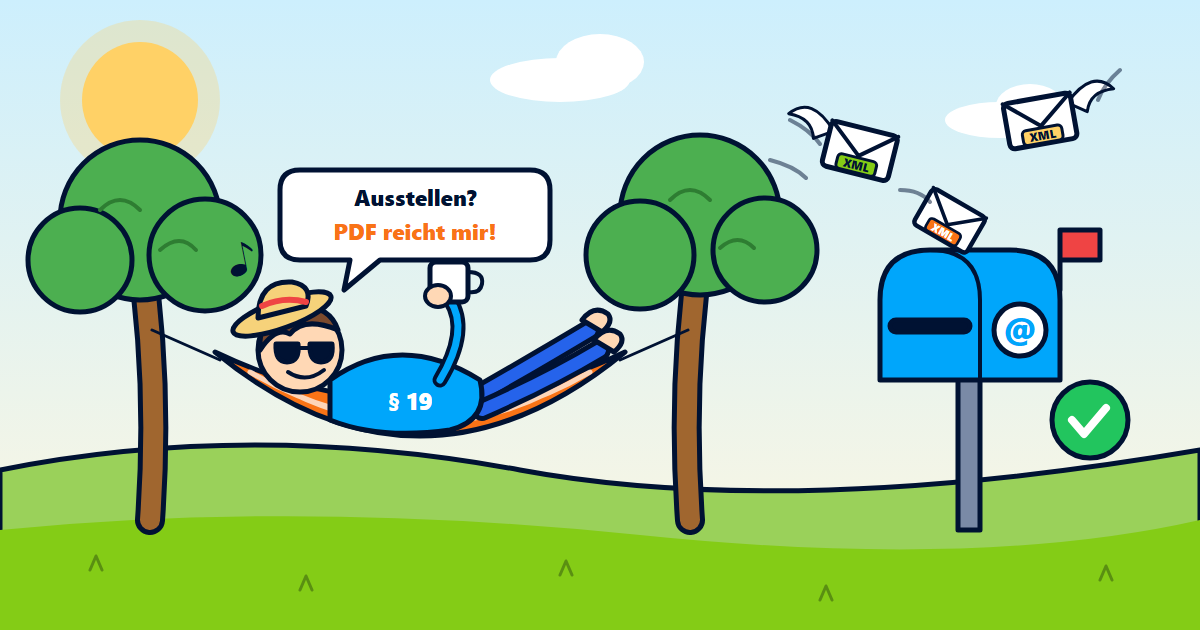
Small businesses (Kleinunternehmer) under § 19 UStG do not have to issue e-invoices: under § 34a UStDV they may continue to write other invoices, for example on paper or as a PDF. Like all businesses, however, they have had to be able to receive e-invoices since Jan. 1, 2025; according to the BMF letter, an email inbox is sufficient for this.
As of: Oct. 26, 2026
This guide is a machine translation of the German original as of Oct. 26, 2026. Only the German version is authoritative: read the German version. If you contact us, please write in German or English.
Issuing: no obligation for small businesses
From Jan. 1, 2027 and Jan. 1, 2028 respectively, businesses must issue invoices to other domestic businesses as e-invoices. For small businesses (Kleinunternehmer) under § 19 UStG, § 34a UStDV makes an exception: they may continue to issue other invoices, i.e. paper invoices or electronic invoices in other formats such as PDF. Turnover plays no role here as long as you apply the small business scheme (Kleinunternehmerregelung).
If you no longer apply the small business scheme, the general deadlines apply to you. They are explained in the article E-invoicing mandate 2027: the €800,000 threshold.
Receiving: mandatory since Jan. 1, 2025
The exception only applies to issuing. Since Jan. 1, 2025, all businesses in Germany have had to be able to receive e-invoices from other domestic businesses – including small businesses. Your suppliers and service providers may therefore send you e-invoices. According to the BMF letter, an email inbox is sufficient for receiving them.
An e-invoice in the XRechnung format is an XML file that is hard to read without a suitable program. How to open it is explained in the article Opening and reading an XRechnung.
Issuing e-invoices voluntarily
You may issue e-invoices as a small business too. This can make sense if a customer requires an e-invoice, such as a public contracting authority with a Leitweg-ID.
In the official ZUGFeRD example for small businesses without a VAT ID (USt-IdNr.), VAT is shown with the category E (exempt), the rate 0 and an exemption reason as text. If the exemption reason is missing, the validation reports the rule BR-E-10. In the invoice form, you enter the category and exemption reason in the “Expert” view, in the “Tax breakdown (BG-23)” section.
How to proceed
- In the E-invoicing mandate check, answer the question about § 19 UStG and see what applies to you.
- Upload received e-invoices to the validator without an account: it validates the file against the official KoSIT validation rules and shows the most important details in readable form.
- With a free account, create invoices in the web form and download them as a ZUGFeRD PDF or XRechnung.
Frequently asked questions
As a small business, do I have to write e-invoices from Jan. 1, 2028?
No. The exception in § 34a UStDV applies regardless of the transitional periods. You may continue to issue paper or PDF invoices.
May I issue e-invoices anyway?
Yes. The exception permits other invoices; it does not prohibit e-invoices. Some customers, such as public contracting authorities, even require an XRechnung.
What do I need to receive e-invoices?
According to the BMF letter, an email inbox through which the e-invoice can reach you is sufficient. To read the file, you need a program that converts the XML into a readable view.
How do I state in an e-invoice that no VAT is charged?
The official ZUGFeRD example for small businesses uses the tax category E (exempt) with tax rate 0 and the exemption reason as text, for example “Kein Ausweis von Umsatzsteuer, da Kleinunternehmer gemäß § 19 UStG” (no VAT shown because of the small business scheme).
Sources
- BMF-Schreiben zur Einführung der obligatorischen E-Rechnung zwischen inländischen Unternehmern (BMF letter on the introduction of mandatory e-invoicing between domestic businesses) (Oct. 15, 2025, III C 2 - S 7287-a/00019/007/243)
- BMF-Schreiben zur obligatorischen E-Rechnung – ergänzende Regelungen (BMF letter on mandatory e-invoicing – supplementary rules) (Oct. 15, 2026, III C 5 - S 7287-a/00019/021/017)
- § 14 UStG (Ausstellung von Rechnungen) (issuing invoices)
- § 34a UStDV (Rechnungen von Kleinunternehmern) (invoices from small businesses)
This article summarises the sources listed in general terms and is not tax or legal advice. For your individual case, please consult a tax advisor.